THE NANO DIET / FIELD GUIDE
READ THE EVIDENCE, THEN COOK
AN IN-DEPTH FIELD GUIDE
Nutritional Yeast: Flavor, Fortification & the NANO Kitchen
A small pantry staple with a big savory role.
How nutritional yeast builds cheesy, buttery-style and chicken-style flavors without animals or oil; what it changes in a recipe; and how to choose fortified flakes without confusing seasoning with a B12 plan.
CHAPTER 01
Meet your new favorite pantry seasoning
Nutritional yeast belongs on the NANO pantry's flavor shelf, beside tomato paste, mushrooms, mustard and miso. It is a purchased ingredient, not a prepared recipe, so this is a Field Guide rather than a new item in Staples & Bases. The sauces and sprinkles made with it belong in those recipe categories. You may also hear it called ‘nooch.’
Its appeal is practical: a spoonful can give a bean sauce a savory finish, help a walnut topping suggest Parmesan, or round out a vegetable gravy. It is useful, not mandatory. You can cook satisfying NANO food without it, and there is no reason to put it into every dish. Think of it as one flavor tool, not the definition of vegan cooking.
Our recipes specify fortified nutritional yeast. That preference makes the B12 question visible, but the amount of added B12 still depends on the product and the portion actually eaten. Flavor and nutrient planning are separate jobs.
CHAPTER 02
What exactly is nutritional yeast?
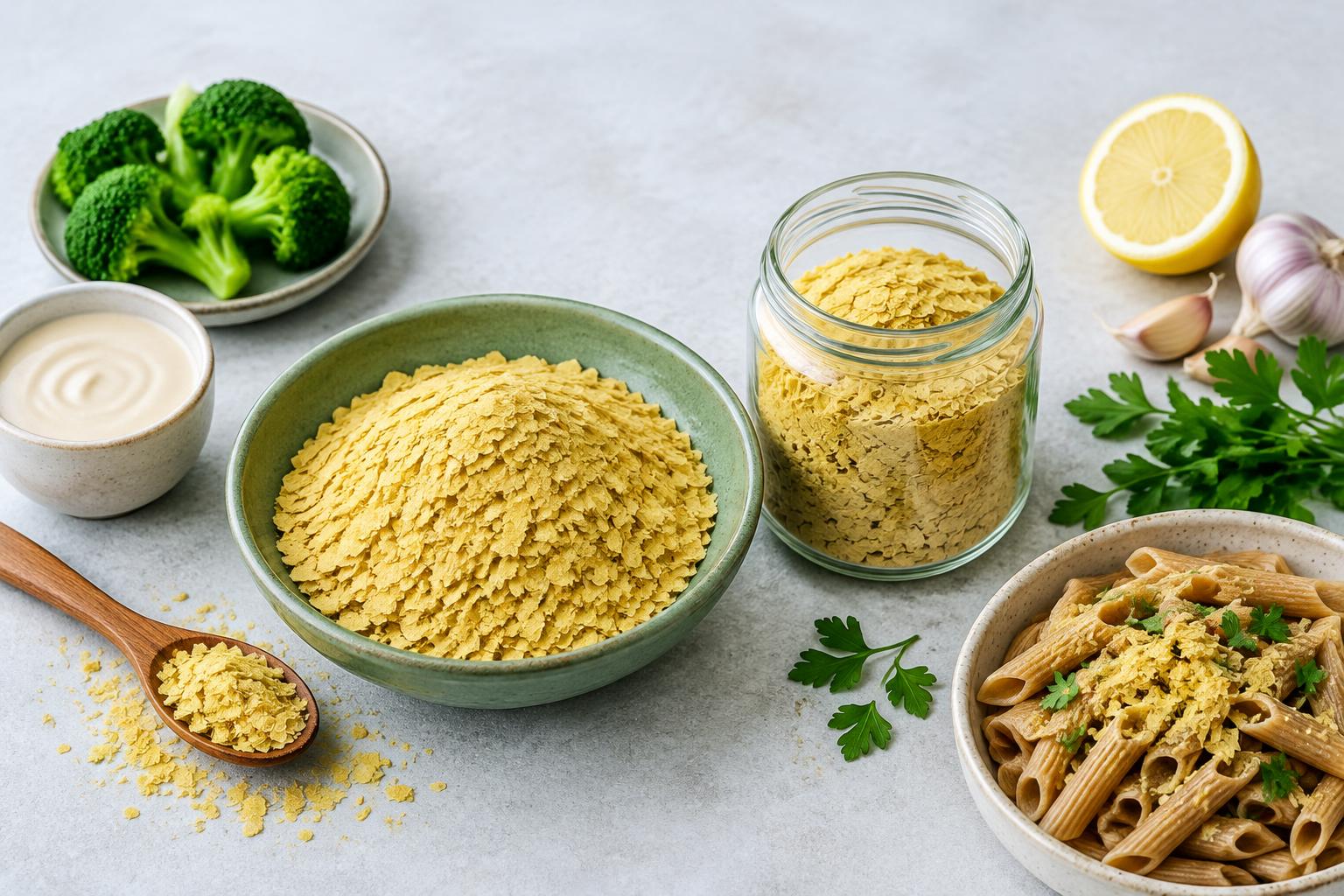
Nutritional yeast is yeast grown for food, then inactivated and dried, commonly sold as thin yellow flakes, granules or powder. It is generally made from Saccharomyces cerevisiae. The Harvard and Vegetarian Resource Group explainers in the source trail describe the product and its processing; these are educational sources, not clinical trials.
Baker's yeast is active and is chosen to make dough rise. Nutritional yeast is inactive: it cannot replace the yeast in whole wheat pizza dough or dinner rolls. Brewer's yeast is a different commercial product, sometimes a by-product of brewing, and may have a more bitter flavor. A jar marked ‘yeast extract’ is also not a spoon-for-spoon replacement for dry nutritional yeast; concentrated spreads and seasonings have different flavor and salt levels.
Flakes are easy to scatter over food. Powder disperses readily in a sauce, but packs more tightly into a spoon. When a recipe gives grams, weigh it rather than assuming that a tablespoon of powder weighs the same as a tablespoon of flakes. Use the household measure on your own package when checking its nutrient label.
CHAPTER 03
Where that rich, savory flavor comes from
Umami means a savory taste, distinct from sweet, sour, salty and bitter. Yamaguchi and Ninomiya's food-science review discusses glutamate and the way umami compounds contribute to food palatability (2000; PMID 10736353). It explains the taste principle—not proof that our recipes have measured sensory scores or health effects. Nutritional yeast's glutamate-containing savory character is described in the educational product sources below.
In cooking, that savory note can connect the rest of a dish: browned mushrooms, sweet onion, a creamy bean base and a little lemon. Yeast does not taste exactly like cheese, butter or chicken by itself. Those associations come from combinations of aroma, acidity, seasoning and texture. A larger dose is not automatically a better imitation.
Try a small side-by-side kitchen comparison: divide a spoonful of your finished sauce into two cups, add a little fortified nutritional yeast to one, and taste both. Does the addition make the sauce fuller, or does it obscure the vegetable? That tells you more about this particular dish than treating ‘nooch’ as a universal finishing powder.
CHAPTER 04
Get cheesy, buttery and chicken-style flavors from plants
For a cheesy direction, combine fortified nutritional yeast with a creamy base and a modest tang. White beans, potato, silken tofu or cashews supply body; lemon juice and a little mustard supply contrast. Garlic or onion can help round out the sauce. Add yeast gradually and taste before adding more acid. This is a vegan cheese-style flavor, not melted dairy cheese: it will not automatically stretch or melt the same way.
For a buttery-style finish, use the yeast as a background savory note rather than the main flavor. A smooth cashew or white-bean sauce, a little onion and restrained acidity can suggest the rounded flavor of a buttery dish. Yeast does not replace butter's fat, moisture behavior or baking structure. Whole-food bases do the texture work; yeast does the seasoning work.
For a chicken-style broth or gravy, pair a smaller amount with onion, celery, garlic, thyme, sage or parsley. Mushrooms can deepen it; a tiny amount of turmeric can change the color, but color is not flavor. Check every stock powder and seasoning blend for animal ingredients and added oil. Call the result chicken-style, not chicken stock, and do not assume that yeast alone recreates it.
These are cooking directions to experiment with, not measured sensory findings. Familiarity and preferences differ: some cooks perceive a nutty, toasted or fermented note more strongly than a cheesy one.
CHAPTER 05
How it changes a sauce, coating or topping
Dry flakes absorb some of a dish's liquid and can make a sauce feel thicker. That can be useful, but yeast is not a dependable substitute for a starch thickener or an egg binder. In a blended sauce, the bean, potato, tofu or nut base should establish the texture first. After adding yeast, let it hydrate briefly, then check whether the sauce needs more water.
On pasta or roasted vegetables, flakes create a soft, slightly dry coating rather than a crisp crust. Mixed with chopped toasted walnuts or crumbs, they become part of a textured topping. On kale chips they work best attached to the recipe's wet coating, not dropped into a bare hot pan. Dry flakes can scorch; avoid frying or dry-toasting them as if they were whole spices.
Yeast can also shift a pale sauce toward yellow and make an otherwise delicate dish taste more assertive. If you want a clean lemon dressing, bright tomato sauce or subtle herb soup, try a small amount first—or leave it out. It is usually out of place in fruit desserts and sweet breakfast dishes. We do not add it simply to make a recipe appear more nutritious.
CHAPTER 06
How much to use, and when to add it
Follow the recipe when one is available. For an improvised sauce, stir a small pinch into a spoonful before seasoning the whole batch. For a modest pot of vegetable broth, start with a teaspoon, taste, and build from there; for a cheese-style sauce, the recipe may deliberately call for much more. These are tasting prompts, not nutrient doses or a universal conversion rule.
Whisk flakes into a little of the sauce liquid before adding them if they clump. In a blender, add them with the other sauce ingredients and enough water to keep the mixture moving. Taste again after blending and heating: a thick, cold mixture may need a different finish once it is poured over hot pasta.
For soups and gravies, stirring yeast in toward the end makes it easier to judge the final strength. For baked toppings, follow the recipe's coating and oven method. An end-of-cooking addition is a flavor-control technique, not a guarantee that all added B12 survives. Do not calculate a cooked dish's absorbed B12 from a package label.
CHAPTER 07
Fortified or unfortified? Here’s what to look for
Fortified means nutrients have been added. A product may contain added B12 along with other B vitamins, but the combination and amounts vary. Look for vitamin B12 in the nutrition panel and inspect the ingredient list for added vitamins; do not rely on yellow color, the word ‘nutritional,’ or a front-label ‘B vitamins’ claim. The Vegetarian Resource Group's product comparison illustrates why the brand and serving size matter. Its historical table is not a current label for the jar in your kitchen.
Unfortified nutritional yeast can still be a useful savory seasoning. It is not a dependable B12 source. ‘Natural’ and ‘unfortified’ do not mean nutritionally superior, and fortified does not mean unlimited quantities are useful. Compare the full panel, especially if you also take a multivitamin or other fortified foods.
In NANO recipes, choose fortified nutritional yeast and check the label. If you deliberately use an unfortified product, the dish may still work as food, but you have changed its B12 contribution. Do not carry over figures from the fortified version. Nor should you assume the same flavor intensity: brands differ, so taste before making a large batch.
CHAPTER 08
Does a sprinkle give you enough B12?
A vegan eating pattern needs a reliable B12 source, such as an appropriate supplement or a deliberately planned fortified-food intake. Melina, Craig and Levin's Academy of Nutrition and Dietetics position paper states that vegans need reliable sources from fortified foods or supplements (2016; PMID 27886704). This is nutrient-planning guidance, not a claim that nutritional yeast treats a disease.
Donaldson's small follow-up study in people eating a mostly raw vegan diet reported improved group methylmalonic acid results with B12 tablets and nutritional yeast (2000; PMID 11146329). It does not establish that any brand, an occasional sprinkle, or every cooked recipe supplies enough B12. The participants and follow-up do not justify using yeast as a substitute for individualized care or deficiency treatment.
To estimate what your label contributes, use: B12 per package serving × amount of yeast in the batch ÷ package serving amount ÷ portions in the batch. Keep both yeast amounts in the same unit. For a purely invented example, a label showing 8 micrograms per 10 g, with 20 g divided among four portions, would contribute a nominal 4 micrograms per portion before cooking. This is arithmetic from a hypothetical label—not a recommended dose, a real brand claim, or absorbed B12.
Our recipe B12 note uses your own label figures. A supplement plan should not disappear just because dinner contains fortified flakes. If deficiency is suspected, or you have been told you have an absorption problem, discuss assessment and treatment with your clinician rather than increasing seasoning.
CHAPTER 09
Choose a jar you will actually use
Buy a small package first if you have not tried the brand. Look for a vegan, oil-free product with a readable ingredient list, a clear serving size and an explicit B12 amount if you want a fortified product. Plain nutritional yeast and a flavored ‘cheese seasoning’ are not necessarily the same thing; mixes may contain oil, milk ingredients or substantial added salt.
Choose flakes for sprinkling and either flakes or powder for blending. Compare price by weight rather than container size. There is no need to buy a large bag because a recipe uses a few spoonfuls, especially if the flavor is new to you. No particular brand is required for our recipes.
Keep the package tightly closed, cool and dry, following its storage instructions and date. Use a dry spoon, keep steam away from the open jar, and avoid shaking it straight over a simmering pot. If it becomes damp, develops mold or smells wrong, discard it. Do not invent a longer shelf life from the fact that the product is dried.
CHAPTER 10
Too much nooch? Here’s how to rescue your sauce
Too yeasty or bitter? Dilute with more of the original unsalted sauce base, not simply more seasoning. If you have a bean sauce, blend in more beans and water; if it is a vegetable gravy, add more unseasoned gravy base. Lemon may brighten a flat sauce, but it will not erase an excessive yeast dose.
Too thick or chalky? Add water or broth gradually, whisk or blend thoroughly, and give the flakes time to hydrate. Check the result on the food it will accompany. A sauce that seems strong on a spoon may be right on plain pasta; one that looks pourable in the blender can thicken as it stands.
Not cheesy enough? Check the whole combination: does it need creaminess, acidity or a little mustard rather than another heap of yeast? If the dish tastes oversalted, do not add more miso or soy sauce. For a chicken-style gravy, herbs and cooked aromatics may be the missing part. Taste one adjustment at a time so you know what helped.
CHAPTER 11
What to use if nutritional yeast isn’t for you
There is no single replacement that reproduces all its jobs. For savory depth, try mushrooms, tomato paste or an oil-free miso preparation that suits the dish. For a crumbly topping, use toasted seeds or walnuts with herbs and lemon zest. For a creamy sauce, keep the bean, tofu or nut base and adjust the acid and aromatics. These swaps change the flavor and do not replace added B12.
Follow allergy restrictions and individual care advice. A sauce with cashews is not a safe default for someone with a nut allergy, and a salty seasoning is not automatically appropriate for a medically restricted diet. Check substitute labels as carefully as the original.
Nooch is not a probiotic: it is inactive. We do not promise it will ‘boost immunity,’ improve the microbiome, or reproduce results from trials of isolated yeast components. The cited B12 paper addresses B12; the umami paper addresses taste. Neither makes every nutritional yeast recipe a therapeutic food.
CHAPTER 12
Try it in these three recipes
Start with our Walnut Parmesan-Style Sprinkle for a crumbly savory topping, Potato-Carrot Vegan Cheese Sauce for a creamy vegetable-based application, or Oil-Free Cheesy Kale Chips for a coating. The recipe links below give the full ingredients and method. Each uses fortified nutritional yeast in a dish where that savory flavor has a clear purpose.
Choose one application rather than seasoning every meal with it immediately. Notice what the yeast does and what the other ingredients do: walnuts supply the crumble; potato supplies body; the kale-chip coating helps flakes adhere. That distinction makes you a more flexible oil-free cook.
Keep the flavor staple on the shelf and keep B12 planning on its own checklist. Nutritional yeast can make NANO cooking more enjoyable without becoming either a compulsory ingredient or a nutrition shortcut.
Cook with fortified nutritional yeast
- Walnut Parmesan-Style Sprinkle →
- Potato-Carrot Vegan Cheese Sauce over Steamed Broccoli →
- Oil-Free Cheesy Kale Chips with Red Pepper →
THE SOURCE TRAIL