THE NANO DIET / SPECIAL REPORT 01
FOOD, FAT & THE EVIDENCE BETWEEN THEM
AN IN-DEPTH FIELD GUIDE
NANO Diet vs. the Mediterranean Diet
The the next whole-food step.
Why we recommend going further with NANO: keep the Mediterranean flavors and whole plant foods, leave out animal ingredients and extracted oil, and read the evidence closely.
CHAPTER 01THE SHORT ANSWER
Keep the Mediterranean flavors. Take the next step with NANO.
Our recommendation is NANO: keep the Mediterranean table’s whole plant foods, leave out animal ingredients and extracted oil, and build richness from food rather than the bottle.
That is a positive case for going further, not a dismissal of Mediterranean eating. PREDIMED found fewer major cardiovascular events with two Mediterranean interventions than with reduced-fat advice in adults at high cardiovascular risk. The pattern deserves credit. The trial does not establish that olive oil is essential, because it never compared the pattern with and without oil.
The direct crossover trial gives the plant-based case real weight: body weight, oral-glucose-test insulin sensitivity and medication-stable cholesterol results favored a low-fat vegan diet. Systolic blood pressure fell more on the Mediterranean diet. These were short-term risk-factor results, not heart-attack or stroke outcomes, and neither arm tested NANO exactly.
The idea that Mediterranean eating works ‘in spite of oil’ is an interpretation advanced by Michael Greger and Forks Over Knives, not a causal result those trials established. We share their preference for whole plant foods over extracted oil. Our recommendation is clear; a claim that NANO is proven clinically superior for every person and every outcome would go beyond the evidence.
Keep
The whole plant foods and Mediterranean flavors.
Leave out
Animal ingredients and extracted oils.
Read honestly
Support for our direction, not proof of every outcome.
CHAPTER 02TWO PATTERNS, SIDE BY SIDE
What stays on the plate, and what changes?
“Mediterranean diet” describes a family of dietary patterns, not one universal menu. NANO is a narrower rule set: No Animals, No Oil. Comparing them fairly means separating their shared foods from the places where they genuinely diverge.
The foundation
MediterraneanVegetables, fruits, beans, lentils, whole grains, nuts, seeds and herbs.
NANOThe same plant-food foundation, with recipes written without animal ingredients or extracted oil.
The main added fat
MediterraneanOlive oil is commonly central, alongside nuts and other foods.
NANONo olive oil or other extracted oil. Whole nuts, seeds, olives and avocados can remain foods.
Animal foods
MediterraneanDefinitions vary, but fish, dairy, poultry and eggs may be included.
NANONone. Beans, lentils, tofu, tempeh and other plant foods take their place in recipes.
What the biggest trial tested
MediterraneanA supplemented Mediterranean pattern against reduced-fat dietary advice.
NANONot the exact NANO pattern and not an oil-free vegan comparison.
What needs separate planning
MediterraneanThe label alone does not specify every nutrient, portion or individual requirement.
NANOVitamin B12 needs a reliable plan; individual nutrient and medical needs still belong with a qualified professional.
CHAPTER 03THE LANDMARK HEART TRIAL
What did the big Mediterranean trial really show about oil?
7,447
Spanish adults at high cardiovascular risk
4.8 years
median follow-up
3
dietary advice groups
Participants were assigned to a Mediterranean diet supplemented with extra-virgin olive oil, a Mediterranean diet supplemented with mixed nuts, or advice to reduce dietary fat. The reanalyzed paper reported hazard ratios of 0.69 for the olive-oil group and 0.72 for the nut group compared with control for its major cardiovascular endpoint.
That is evidence for the interventions against that comparator in this population. It is not a three-way trial of olive oil versus nuts alone, and it does not show that adding olive oil to any diet produces the same result. Both active groups received a broader Mediterranean dietary intervention.
Read the paper’s study note: Estruch et al., 2018.
MAJOR CARDIOVASCULAR EVENTS
How the three groups compared
3.8%
Mediterranean + extra-virgin olive oil
3.4%
Mediterranean + mixed nuts
4.4%
advice to reduce dietary fat
Percentages are the event rates reported in the reanalysis over a median 4.8 years. The comparison was not vegan or oil-free.
WHAT IT SUPPORTS
Two structured Mediterranean dietary interventions can outperform reduced-fat advice for a major cardiovascular endpoint in the studied high-risk population.
WHAT IT DOES NOT SHOW
That olive oil is essential, that NANO was tested, or that the results automatically transfer to every lower-risk person and every way of eating Mediterranean food.
THE IMAGING FOOTNOTE
In the small PREDIMED imaging substudy, the nut group had more favorable internal-carotid thickness and maximum plaque-height changes than controls; the olive-oil group showed no changes in these measures. That strengthens the case for taking whole nuts seriously rather than putting all the credit on oil. It does not establish a statistically tested nuts-over-oil advantage, and neither group was oil-free. These were ultrasound surrogates, not coronary-plaque reversal, strokes or heart attacks. Read the imaging study note →
CHAPTER 04THE DIRECT CROSSOVER
What happened when people tried both diets?
62
overweight adults
16 weeks
on each diet, in random order
Risk factors
measured—not heart attacks or strokes
This is the most direct comparison in our ledger, and its weight, cholesterol and oral-glucose-test insulin-sensitivity findings favor low-fat vegan eating. That is meaningful support for moving beyond an oil-centered Mediterranean menu, although it cannot tell us how much of the difference came from removing oil versus the other dietary changes.
The vegan arm was low-fat, but that does not make it a trial of NANO’s exact food rules or recipes. The Mediterranean arm likewise represents the investigators’ intervention, not every diet sold under the Mediterranean name.
OUTCOME
Mediterranean
Low-fat vegan
Body weight
Mediterranean0.0 kg net change
Low-fat vegan−6.0 kg net change
Favored the low-fat vegan diet
Insulin sensitivity (OGIS)
MediterraneanNo significant change
Low-fat veganGreater improvement
Oral-glucose-test measure favored low-fat vegan eating; other insulin indices did not show significant between-diet changes
LDL cholesterol
MediterraneanSmaller reduction
Low-fat veganAbout 15 mg/dL greater reduction
Among participants whose medicines stayed stable
Systolic blood pressure
Mediterranean−9.3 mmHg
Low-fat vegan−3.4 mmHg
Fell on both; more on the Mediterranean diet
Source: Barnard et al., 2022. The vegan arm is labeled “low-fat vegan,” not NANO.
CHAPTER 05THE OLIVE-OIL QUESTION
Do you need olive oil to eat well?
A successful dietary pattern does not give every ingredient an automatic health endorsement. PREDIMED’s olive-oil intervention had favorable cardiovascular results, which we retain in full. But a pattern supplemented with oil is not a test of whether that same pattern would do better, worse or equally well without it. NANO does not treat oil as the price of admission to Mediterranean flavors.
NANO makes a different kitchen choice: keep fats attached to whole foods and leave extracted oils out. USDA FoodData Central lists olive oil at 884 calories per 100 g. At 13.5 g per tablespoon, that is about 119 calories, with no fiber or protein. For weight loss, removing those calories matters; it does not mean oil alone explains weight gain.
Vogel and colleagues provide a specific reason to question the halo: in 10 healthy volunteers, the olive-oil meal temporarily reduced flow-mediated dilation, a measure of artery function. Adding salad and balsamic vinegar or antioxidant vitamins changed that response. The other meals—including canola oil and salmon—did not significantly reduce the measure, so this experiment is not proof that all oils have the same effect. Nor does it establish long-term harm or show that an oil-free diet prevents disease.
The meal experiment: Vogel et al., 2000.
Our choice is to keep the whole plant foods and skip extracted oil—not to give the bottle credit for everything good about the Mediterranean table.
CHAPTER 06THE WIDER EVIDENCE
Five more studies worth a closer look
A deep comparison should not stop at the two most quotable papers. These studies add useful context about arteries, the microbiome, liver fat and no-added-oil eating. They also show why study design matters as much as whether a result appears to favor our preferred menu.
01
GUT & AGING
What a Mediterranean trial found about gut bacteria and aging
The one-year, five-country Mediterranean intervention in older adults linked adherence with microbial patterns and inflammatory markers. The authors connected those patterns with frailty and cognitive measures. The randomized diet does not make every observational microbe-to-health association causal, and this was not an oil-free vegan intervention.
02
LIVER FAT
What happened to liver fat on a green-Mediterranean diet?
DIRECT-PLUS measured intrahepatic fat over 18 months in a three-arm randomized dietary trial that also included physical activity. A green-Mediterranean result cannot be credited to a single ‘superfood,’ transferred directly to NANO or reduced to a universal claim about liver disease.
03
COMPREHENSIVE LIFESTYLE
The heart trial that changed food, exercise and more
The small randomized trial combined a low-fat vegetarian diet with exercise, stress management and smoking cessation. Angiographic coronary narrowing improved in the intervention group after one year while it progressed with usual care. Diet alone cannot be isolated from the full program.
04
FIVE-YEAR FOLLOW-UP
What the same heart trial found five years later
The five-year report found sustained differences in coronary narrowing and recorded fewer cardiac events in the comprehensive lifestyle group. It was follow-up of the Lifestyle Heart Trial, not an independent replication. Attrition and the multicomponent intervention still limit the conclusion.
05
NO-ADDED-OIL CASE SERIES
What an oil-free patient study can tell us
This volunteer case series included 198 patients, with 177 classified as adherent to a plant-based, no-added-oil program. Fewer recurrent events were reported among adherent participants. Without randomization or a concurrent usual-care control, the comparison cannot establish causation. Relevance to NANO’s rules does not turn it into a randomized NANO trial.
CHAPTER 07A SEPARATE LEDGER
What else do you need to plan when you change your diet?
A dietary pattern can look excellent in a food list and still need deliberate nutrient planning. Conversely, removing a food does not make its replacement nutritionally identical. Keep those questions separate from the trial headlines.
Make a reliable B12 plan
Removing all animal foods requires a reliable vitamin B12 plan, usually through fortified foods or a supplement chosen with a qualified professional. A food-source review by Watanabe and colleagues also explains why the presence of a B12-like compound in a plant food is not enough: active vitamin and inactive analogues must be distinguished.
Replacing fish? Check nutrients as well as flavor
Beans, lentils and tofu can replace fish in the structure of a meal without making their nutrient profiles identical. NANO readers should review the whole diet—including omega-3 fats and other individual needs—rather than assume a one-for-one ingredient swap settles every question.
Whole nuts and extracted oils aren’t the same food
PREDIMED’s nut and olive-oil groups both belong to the evidence, but their results do not prove that every whole fat and extracted fat are interchangeable. NANO’s distinction is about food form: whole nuts and seeds retain more of the original food than their extracted oils.
This report does not provide supplement doses or an individual nutrient prescription. Pregnancy, childhood, kidney disease, medicines and other circumstances need individualized professional care.
CHAPTER 08FROM MEDITERRANEAN TO NANO
Keep the flavors you love, and change how you cook
The easiest transition is not a suitcase of specialty substitutes. Start with the Mediterranean dishes and ingredients you already like, then change the cooking method, the source of richness and the center of the plate.
01
Keep the plant foods you already enjoy
Do not discard the vegetables, fruit, beans, lentils, intact whole grains, nuts, seeds and herbs that already make a Mediterranean plate useful.
02
Sauté with water or vegetable broth
Soften onions and garlic with small additions of water or unsalted vegetable broth. Deglaze the browned bits instead of treating oil as the only route to flavor.
Make oil-free vegetable broth: Oil-Free Vegetable Broth03
Blend whole foods into creamy sauces
Blend cashews or white beans for body, and use lemon, vinegar, mustard, garlic and herbs for brightness. The aim is a satisfying sauce, not an imitation of oil’s mouthfeel.
Make oil-free cashew cream: Oil-Free Cashew Cream04
Choose nuts, seeds and avocados instead of their oils
Use nuts, seeds, olives or avocado as foods with texture and chewing, rather than pouring their extracted oils over the finished plate. Portions and individual needs still matter.
05
Build a satisfying main dish from plants
Build the center of the plate around beans, lentils, tofu or tempeh, then review nutrient needs separately. A culinary replacement is not a claim of nutritional identity.
06
Give your favorite dishes an oil-free makeover
Whole wheat pizza does not need oil in its dough. Tomato, vegetables, herbs, beans and a whole-food sauce can carry the Mediterranean flavors forward under NANO rules.
Make whole wheat pizza dough: Oil-Free Whole Wheat Pizza Dough
CHAPTER 09WHY WE RECOMMEND NANO
Why we recommend taking the next step with NANO
Mediterranean eating is a worthwhile starting point, not something to trash. Its plant-rich recipes and food traditions give us much to keep. We recommend building on that foundation with NANO: no animal foods, no extracted oils, and satisfying meals organized around whole plant ingredients.
Why go further? The direct trial favors low-fat vegan eating for weight, cholesterol and one insulin-sensitivity measure; whole nuts have their own supportive evidence; and leaving oil out removes a concentrated source of calories without giving up Mediterranean flavors. Together these make our case for NANO—not proof of universal superiority, and not evidence that oil alone explains the trial differences.
Moving to NANO still calls for deliberate nutrition planning and appropriate medical care. Make a reliable B12 plan and review nutrient needs and medicines with a qualified clinician or dietitian. Kidney disease, pregnancy, childhood and other circumstances need individualized advice. We recommend the NANO direction without promising that it prevents or reverses anyone’s disease.
Four questions to take to your clinician or dietitian
- 01What outcome am I trying to change, and has that outcome actually been measured?
- 02Will I reliably include a source of vitamin B12 and review my other nutrient needs?
- 03Could a change in diet change my need for blood-pressure, cholesterol or diabetes medicine?
- 04Can I prepare satisfying food within my time, budget and household?
This guide is for education, not diagnosis or treatment. Do not start, stop or change prescribed medicines or supplements from a web page.
READER QUESTIONS
Frequently Asked Questions
Is NANO just a stricter Mediterranean diet?
They overlap heavily in plant foods, but they are not interchangeable labels. Mediterranean patterns commonly include olive oil and may include fish, dairy, poultry and eggs. NANO excludes all animal foods and all extracted oils. The shared foundation does not make their trial evidence interchangeable.
Did PREDIMED prove that olive oil prevents heart attacks?
No. It tested a Mediterranean dietary intervention supplemented with extra-virgin olive oil and another supplemented with nuts against reduced-fat advice. It did not isolate olive oil or compare it with NANO. The major cardiovascular endpoint included myocardial infarction, stroke or cardiovascular death, rather than heart attacks alone.
Did the vegan diet win the head-to-head trial?
It won several measured comparisons, not every one. Weight, insulin sensitivity and medication-stable cholesterol results favored the low-fat vegan diet; systolic blood pressure fell more on the Mediterranean diet. The trial was small, short and measured risk factors rather than clinical events.
Why not simply use a small amount of olive oil?
NANO’s rule is a deliberate definition, not a dose-response claim: no extracted oils. One tablespoon contains about 119 calories and no fiber or protein, while the whole food retains more of its original structure. That choice does not require calling olive oil poisonous or denying the favorable Mediterranean evidence.
Does Mediterranean eating work in spite of olive oil?
That is Greger’s and Forks Over Knives’ interpretation, and we favor its whole-food direction. The meal experiment raises concerns about an olive-oil meal’s short-term artery response, while PREDIMED supports whole dietary interventions. Neither establishes that oil cancels benefits or that removing it improves every outcome. NANO keeps the plant-rich foundation without making extracted oil a requirement.
Can I keep eating Mediterranean-inspired dishes?
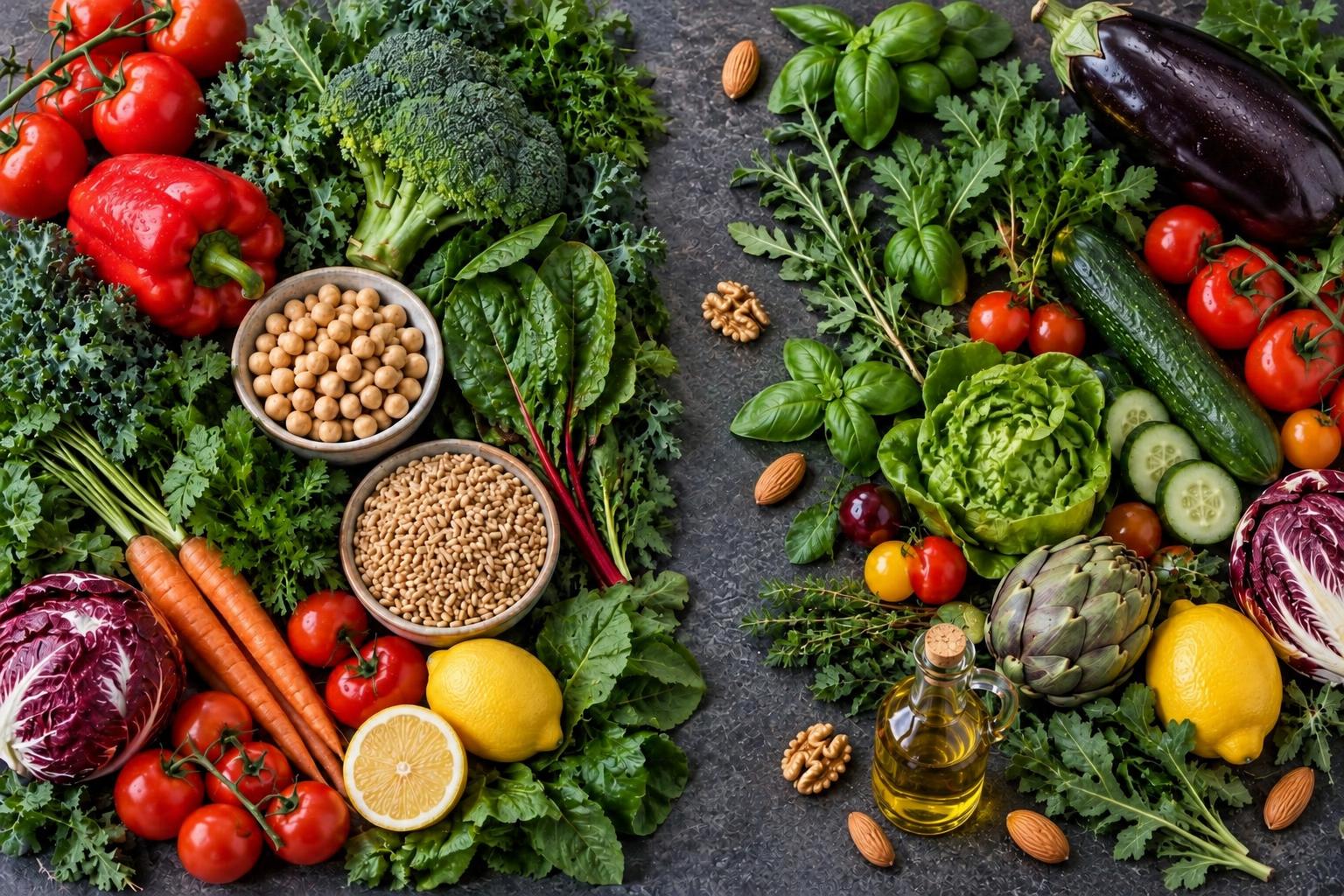
Yes. Tomatoes, garlic, lemon, herbs, beans, lentils, vegetables, whole grains, nuts and seeds all cross the boundary. Water sautéing, whole-food sauces and oil-free breads preserve the flavors and meal structure without adding extracted oil.
CHAPTER 10PRIMARY PAPERS & SOURCE TRAIL
Read the original studies
Every numbered finding above returns to a registered PubMed-indexed paper. Study notes explain the design and limitations; the DOI and PubMed links let you inspect the original record.
- 01
Primary Prevention of Cardiovascular Disease with a Mediterranean Diet Supplemented with Extra-Virgin Olive Oil or Nuts
PREDIMED, reanalyzed: 7,447 Spanish adults at high cardiovascular risk were assigned a Mediterranean diet with extra-virgin olive oil, one with mixed nuts, or advice to reduce dietary fat. Over a median 4.8 years, major cardiovascular events occurred in 3.8%, 3.4% and 4.4% (hazard ratios 0.69 and 0.72 vs control). The 2013 report was withdrawn after randomization problems at some sites. The comparison was a reduced-fat advice diet, not a vegan or oil-free one.
Estruch R, Ros E, Salas-Salvadó J, et al.. New England Journal of Medicine 378(25):e34, 2018. PMID 29897866 · DOI
- 02
A Mediterranean Diet and Low-Fat Vegan Diet to Improve Body Weight and Cardiometabolic Risk Factors: A Randomized, Cross-over Trial
62 overweight adults ate a Mediterranean diet and a low-fat vegan diet for 16 weeks each, in random order. Net weight change was 0.0 kg on the Mediterranean diet and −6.0 kg on the vegan diet; insulin sensitivity and, among people without medication changes, total and LDL cholesterol improved more on the vegan diet. Blood pressure fell on both, more on the Mediterranean diet. Small, unblinded and run by a vegan-advocacy group; no heart events were measured.
Barnard ND, Alwarith J, Rembert E, et al.. Journal of the American Nutrition Association 41(2):127–139, 2022. PMID 33544066 · DOI
- 03
The postprandial effect of components of the Mediterranean diet on endothelial function
Acute meal experiment in 10 healthy participants: an olive-oil-containing meal temporarily reduced flow-mediated dilation, a surrogate endothelial measure. Responses differed with meal composition, including salad/vinegar and antioxidants. This does not establish long-term harm from olive oil or benefits of eliminating all oils.
Vogel RA, Corretti MC, Plotnick GD. Journal of the American College of Cardiology 36(5):1455–1460, 2000. PMID 11079642 · DOI
- 04
Changes in ultrasound-assessed carotid intima-media thickness and plaque with a Mediterranean diet: a substudy of the PREDIMED trial
In a small PREDIMED imaging substudy, the Mediterranean-plus-nuts group had more favorable changes in internal-carotid thickness and maximum plaque height than controls over roughly 2.4 years. These segment-specific ultrasound findings are not coronary-plaque reversal or heart-attack outcomes. This was not a vegan or zero-oil intervention.
Sala-Vila A, Romero-Mamani ES, Gilabert R, et al.. Arteriosclerosis, Thrombosis, and Vascular Biology 34:439–445, 2014. PMID 24285581 · DOI
- 05
Mediterranean diet intervention alters the gut microbiome in older people reducing frailty and improving health status: the NU-AGE 1-year dietary intervention across five European countries.
The older-adult study connected Mediterranean-diet adherence, microbial patterns and inflammatory markers without proving that bacteria prevented clinical decline.
Ghosh TS, Rampelli S, Jeffery IB, Santoro A, Neto M, Capri M, Giampieri E, Jennings A, Candela M, Turroni S, Zoetendal EG, Hermes GDA, Elodie C, Meunier N, Brugere CM, Pujos-Guillot E, Berendsen AM, De Groot LCPGM, Feskins EJM, Kaluza J, Pietruszka B, Bielak MJ, Comte B, Maijo-Ferre M, Nicoletti C, De Vos WM, Fairweather-Tait S, Cassidy A, Brigidi P, Franceschi C, O'Toole PW.. Gut, 2020. PMID 32066625 · DOI
- 06
Effect of green-Mediterranean diet on intrahepatic fat: the DIRECT PLUS randomised controlled trial.
A green-Mediterranean intervention measured liver fat, not a stand-alone superfood cure.
Yaskolka Meir A, Rinott E, Tsaban G, Zelicha H et al.. Gut, 2021. PMID 33461965 · DOI
- 07
Can lifestyle changes reverse coronary heart disease? The Lifestyle Heart Trial
Randomized controlled trial: after one year, patients following a low-fat vegetarian diet with exercise, stress management and smoking cessation showed regression of coronary stenosis on angiography, while the usual-care group progressed.
Ornish D, Brown SE, Scherwitz LW, et al.. The Lancet 336(8708):129–133, 1990. PMID 1973470 · DOI
- 08
Intensive lifestyle changes for reversal of coronary heart disease
Five-year follow-up of the same small Lifestyle Heart Trial, not an independent replication. Mean coronary narrowing improved in the comprehensive lifestyle group and progressed in controls; fewer cardiac events were recorded. Attrition and the multicomponent intervention limit interpretation.
Ornish D, Scherwitz LW, Billings JH, et al.. JAMA 280(23):2001–2007, 1998. PMID 9863851 · DOI
- 09
A way to reverse CAD?
Uncontrolled volunteer case series of 198 patients: 177 were classified as adherent to a plant-based, no-added-oil program. The authors reported fewer recurrent events among adherent participants; without randomization or a concurrent usual-care control, the comparison cannot establish causation.
Esselstyn CB Jr, Gendy G, Doyle J, Golubic M, Roizen MF. Journal of Family Practice 63(7):356–364b, 2014. PMID 25198208
- 10
Vitamin B₁₂-containing plant food sources for vegetarians.
Reading a food-source review requires separating active vitamin from inactive analogues.
Fumio Watanabe, Yukinori Yabuta, Tomohiro Bito, Fei Teng. Nutrients, 2014. PMID 24803097 · DOI