Red and processed meat: what a legume swap can—and cannot—claim
Prospective evidence links higher meat intake with colorectal cancer, but does not quantify a bean-for-meat intervention.
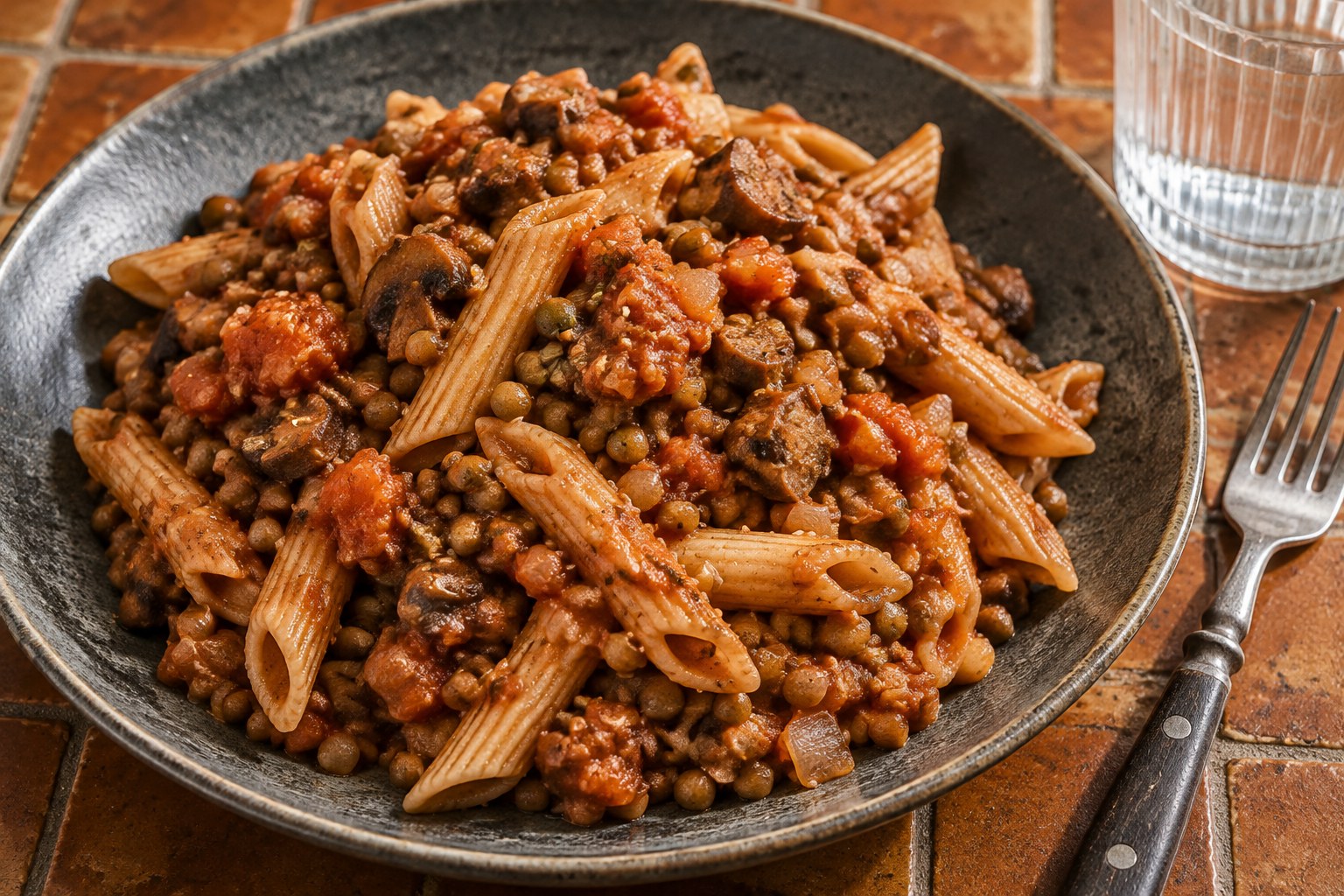
Illustrative food image, not a photograph of the study intervention.
Read the comparison before planning the swap
This 2011 meta-analysis updated prospective evidence on red and processed meat and colorectal cancer incidence. The authors searched PubMed through March 2011, pooled relative risks using random-effects models, and examined both intake categories and dose-response relationships. Its comparisons concern levels of meat intake; they do not randomly assign people to replace meat with lentils. That distinction matters when turning the findings into dinner advice. A legume-centered meal can be presented as a practical way to build a meal without meat, but this paper cannot attach a specific cancer-risk reduction to that particular replacement.
Chan DS, Lau R, Aune D, Vieira R et al.. PloS one, 2011. PMID 21674008 · DOI
Keep the units attached
For red and processed meats considered together, the highest versus lowest intake comparison gave a relative risk of 1.22 (95% CI 1.11–1.34). The pooled estimate per 100 g/day higher intake was 1.14 (1.04–1.24). Separate analyses used different increments: fresh red meat had a relative risk of 1.17 per 100 g/day (1.05–1.31), while processed meat had a relative risk of 1.18 per 50 g/day (1.10–1.28). Those numbers cannot be compared as though both refer to the same portion. They are relative associations, not the absolute probability that an individual will develop cancer.
Chan DS, Lau R, Aune D, Vieira R et al.. PloS one, 2011. PMID 21674008 · DOI
The curve and the cancer site matter
The nonlinear analysis suggested an approximately linear increase in colorectal cancer risk up to about 140 g/day of red and processed meat, followed by a curve approaching a plateau. That shape is a description of pooled observational data, not a safety threshold or permission to disregard intake beyond it. The combined exposure showed similar associations for colon and rectal cancer. When fresh red meat and processed meat were analyzed separately, the abstract reported significant associations for colorectal and colon cancer but not rectal cancer. Preserving those qualifications is more informative than suggesting identical certainty for every exposure and anatomical site.
Chan DS, Lau R, Aune D, Vieira R et al.. PloS one, 2011. PMID 21674008 · DOI
Make the lentil meal a practical choice
A lentil shepherd tray offers a concrete meal format that does not need red or processed meat. Here, legumes are the proposed cooking swap, not a protective ingredient tested by the meat meta-analysis. The authors concluded that the prospective evidence supported limiting red and processed meat as one dietary recommendation for colorectal cancer prevention. Because these were prospective studies rather than a randomized substitution trial, their pooled associations do not isolate a causal effect of replacing a given serving with beans. The defensible message is about reducing reliance on the studied exposure, without inventing a numerical benefit for its replacement.
Chan DS, Lau R, Aune D, Vieira R et al.. PloS one, 2011. PMID 21674008 · DOI